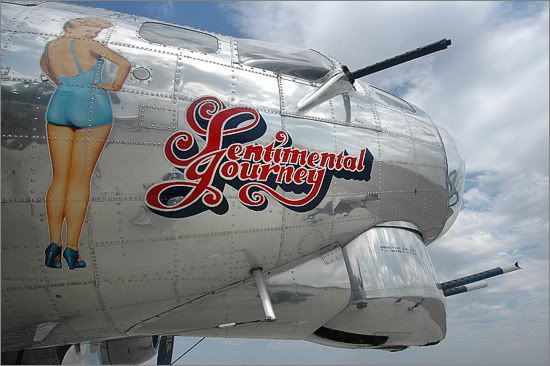
In today’s society, an image such as the one above may be offensive to some people, especially considering the fact that it appears prominently on the front of a government owned aircraft. But before judgment is passed on this situation, one should consider the circumstances under which it was painted.
During World War II the United States had air crews flying and maintaining different kinds of aircraft allover the world. The Pacific and Europe were the biggest theatres of operation, and the farther away from the various headquarters and main bases the racier the pictures got. But why were these pictures necessary, or even allowed for that matter? The simple fact is that these crews on average were very young with the average age being in the early twenties. These young men were away from home for very long periods of time, and came to miss families, girlfriends and wives, and other nostalgic memories of their homes. Anne Josephine Hayward, a member of the American Red Cross Aero Club in England and a painter of nose art, challenges current objections to nose art as degrading to women or others: "Its purpose was worthy, to bolster military morale in a terrible time. The members of each crew came to feel that their plane and their painting were somehow special and would bring them luck, a safe return from hostile skies. The art may have been frivolous at times, but it was never anti-social" (Source found here).
This may sound like an easy answer to explain away such behavior, but from personal experience I find it to be very accurate. When in a combat environment, no matter how well you’re trained or how confident you are in yourself or those around you, luck and fate are always there in your subconscious. These young men, especially the bomber pilots, were often in harms way. “8th Air Force Combat Losses in Europe was heavy. You had a higher percentage of being killed, wounded or captured while flying in the 8th AF than if you were in the infantry in the front line. Like all statistics, this fact is high when you compare the 8th AF losses against all personnel in the units that were considered "in combat." In actuality, it was even higher if you only count the front line regiment combat personnel and not the whole division. A US division was 16,000 or so personnel with only 3,600 being the front line infantry combat troops - all the others were support personnel." (Source can be found here.)
Because of statistics like this, more leeway was granted to these individuals for personalizing their aircraft. In a historical context, the 8th Air Force flew bombers mainly over European targets, especially Germany. Often times their losses were horrendous and friends and fellow airmen didn’t come back home. This of course didn’t have a good effect on morale. However, just the simple act of letting these men put this sort of art work on their planes gave them something else to be motivated about, to strive for, besides dwelling on the fact that they could be facing impending doom every time they took to the skies. The camaraderie that was built among air crews as they had friendly competitions over their nose art was also a much needed distraction during a time of awful endeavors.

So once again I say, don’t judge these individuals as being sexist or anything of the like. Perhaps some were, but when you get right down to brass tacks, this simple expression of art, these reminders of home and of what was waiting, is what helped get these brave men through what may be one of the most trying times in our history. Go art!

