Showing posts with label American art. Show all posts

Tuesday, July 28, 2009

STUDENT POST: WWII Airplane Nose Art

by: Benjamin Mohar, undergraduate art history student


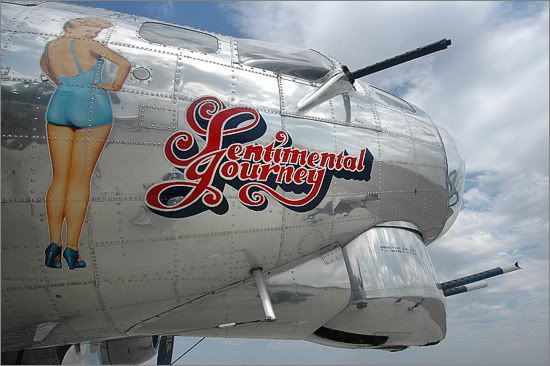
In today’s society, an image such as the one above may be offensive to some people, especially considering the fact that it appears prominently on the front of a government owned aircraft. But before judgment is passed on this situation, one should consider the circumstances under which it was painted.


During World War II the United States had air crews flying and maintaining different kinds of aircraft allover the world. The Pacific and Europe were the biggest theatres of operation, and the farther away from the various headquarters and main bases the racier the pictures got. But why were these pictures necessary, or even allowed for that matter? The simple fact is that these crews on average were very young with the average age being in the early twenties. These young men were away from home for very long periods of time, and came to miss families, girlfriends and wives, and other nostalgic memories of their homes. Anne Josephine Hayward, a member of the American Red Cross Aero Club in England and a painter of nose art, challenges current objections to nose art as degrading to women or others: "Its purpose was worthy, to bolster military morale in a terrible time. The members of each crew came to feel that their plane and their painting were somehow special and would bring them luck, a safe return from hostile skies. The art may have been frivolous at times, but it was never anti-social" (Source found here).


This may sound like an easy answer to explain away such behavior, but from personal experience I find it to be very accurate. When in a combat environment, no matter how well you’re trained or how confident you are in yourself or those around you, luck and fate are always there in your subconscious. These young men, especially the bomber pilots, were often in harms way. 8th Air Force Combat Losses in Europe was heavy. You had a higher percentage of being killed, wounded or captured while flying in the 8th AF than if you were in the infantry in the front line. Like all statistics, this fact is high when you compare the 8th AF losses against all personnel in the units that were considered "in combat." In actuality, it was even higher if you only count the front line regiment combat personnel and not the whole division. A US division was 16,000 or so personnel with only 3,600 being the front line infantry combat troops - all the others were support personnel." (Source can be found here.)


Because of statistics like this, more leeway was granted to these individuals for personalizing their aircraft. In a historical context, the 8th Air Force flew bombers mainly over European targets, especially Germany. Often times their losses were horrendous and friends and fellow airmen didn’t come back home. This of course didn’t have a good effect on morale. However, just the simple act of letting these men put this sort of art work on their planes gave them something else to be motivated about, to strive for, besides dwelling on the fact that they could be facing impending doom every time they took to the skies. The camaraderie that was built among air crews as they had friendly competitions over their nose art was also a much needed distraction during a time of awful endeavors.


So once again I say, don’t judge these individuals as being sexist or anything of the like. Perhaps some were, but when you get right down to brass tacks, this simple expression of art, these reminders of home and of what was waiting, is what helped get these brave men through what may be one of the most trying times in our history. Go art!


Thursday, July 16, 2009

What's so American about American art? Pt. I

"Of course, it is well to go abroad and see the works of the Old Masters, but Americans [must] strike out for themselves, and only by doing this will we create a great and distinctly American art." -- Thomas Eakins (1844-1916)

This was made by an American*:

Thomas Cole, The Oxbow, 1836, oil on canvas, 51.5" x 76 inches.
Metropolitan Museum of Art, New York City


So was this:


Jean-Michel Basquiat, Untitled, 1981, oil stick on paper, 40" x 60".
Museum of Modern Art, New York City


And this:

John Steuart Curry, Tornado Over Kansas (1929), oil on canvas, approx. 47" x 60".
Muskegon Museum of Art, Muskegon, Michigan


This too:

Ann Hamilton, Reflection (12:00 to 12:55), 1999-2001, suite of twelve iris prints.
Alrbright-Knox Art Gallery, Buffalo, New York.


And also this:

Robert Henri, Betalo Nude (1916), oil on canvas, 41" x 33".
Milwaukee Art Museum, Milwaukee, Wisconsin.


We are a unique people (or so we like to believe): our ancestors/grandparents/parents/ourselves had enough hope and optimism to leave behind friends and family, to leave behind a threatening political/military situation, with the determination that they (we?) could make it in the new land. This promise of freedom has brought immigrants from literally every country in the world, and created our great melting pot of diversity.

But then if we are a melting pot of diversity, how can we categorize ourselves? Sure, "American" food is hotdogs, hamburgers, and apple pie. But when I really think "American" and "food," I think of diversity and access: that in one town, I get a mulitude of different types of foods whenever I want. What's more American than eggs from a local diner for breakfast, Thai food for lunch, ordering a pizza for dinner, and then going out and drinking a Chinese beer?

But I digress. Pretty much since the inception of the British colonies and then the nation, the United States, Americans have long-struggled with their cultural and artistic identity. How are we the same, but different from Europe? In some cases, how are we better than Europe? It's hard to stack up a measly two centuries of history when places like India, China, Italy, and Greece have traditions of artistic production dating back to BCE? Or places like London and Paris, which just reek of artistry, architecture, and culture?

When we teach art history, we can give characteristics for regional styles: Italian Renaissance art shows the influence of classical humanism, Dutch art has a lot of landscapes and still lifes, etc. What characteristics can we assign art that has been created since 1776? In other words: what's so American about American art? Is it desirable in a nation of immigrants that all proudly, simultaneously claim their old and new nationalities (German-American, Asian-American, etc.) to stylistically categorize it all as "American"?

This topic can clearly be controversial and personal. Rather than try to answer questions or propose solutions, I'll try steer this post series towards the history of how Americans have tried to define their artistic identity. What did "American art" mean in in 1853, 1933, 1953, 1973 or 2003? Who were the Americans creating art of the colonial settlers? Who was writing about art at those times? Where were artists being trained? Which artists conscioiusly tried to create "American art" and which ones created art that has become perceived as quintessentially American? What does that tell us about the history of the United States?

*Note: the term "American" has recently become an ideological minefield, mostly concerning colonialism, post-colonialism, imperialism, and nationalism. The term "American" does not inherently mean "from the United States of America" but can also be applied to those of North, Central, and South American. To write that something is American and have it instantly mean "United States" has come under fire by those from other countries in the Americas, as qualifying that something is Central or Southern American may inadvertantly (one may hope) mark it is from the Other. Rodolfo Acuna's essay "Occupied America" uses the specific case of the Southwest United States to demonstrate how colonization has taken not only land but also appropriated an "Other" culture in the name of "American" (United States) identity. In this post, the term "American" is used to denote "from the United States of American." In no way does this intend to denegrate or disrespect those from other Americas. Rather, it is out of convenience for a catchy title. However, I also think that adding this bit of information can also open new avenues of discussion in hopes of achieving a new understanding between cultures and countries.