By: Jay Freerking, undergraduate art history student
The most common phrase heard in public art museums is “What the heck is that supposed to be?” The public that isn’t familiar with art struggle to understand some of the paintings in the art world. In fact there is a lot of art in the world that isn’t eye catching to people. There is one area of art that everyone can appreciate and not necessarily known as art, it is architecture. Architecture is the art of designing a building and seeing it through the building process.
On specific architect whose work can be viewed as art was Frank Lloyd Wright. He was born in Richland Center, WI in 1867 and died at Taliesin West, AZ in 1959. He attended the University of Wisconsin Madison for a short period studying mechanical drawing. He didn’t last the full tenure so he became an apprentice for an architect in Chicago. He became famous on his own after designing some of the most luxurious houses. He had two houses, one in Spring Green WI called Taliesin and another in Phoenix, AZ called Taliesin West. He didn’t like the summers in Arizona and he didn’t like the winters in Wisconsin so he commuted every season change between the two. He even formed his own school, The Frank Lloyd Wright School of Architecture. His students followed him on every trip and the school continues that tradition today with all of its full time students with the two houses serving as campuses.
Wright hated the idea of tradition “box” rooms, as he put it. He believed that houses should be big and open. He liked to combine rooms by leaving out walls. He came up with the first Great room. That is a room that combines the kitchen, living room, and dining room all into one big room separated by arches and dimension differences. The picture below from Fallingwater in Pennsylvania has an open room as you can see.
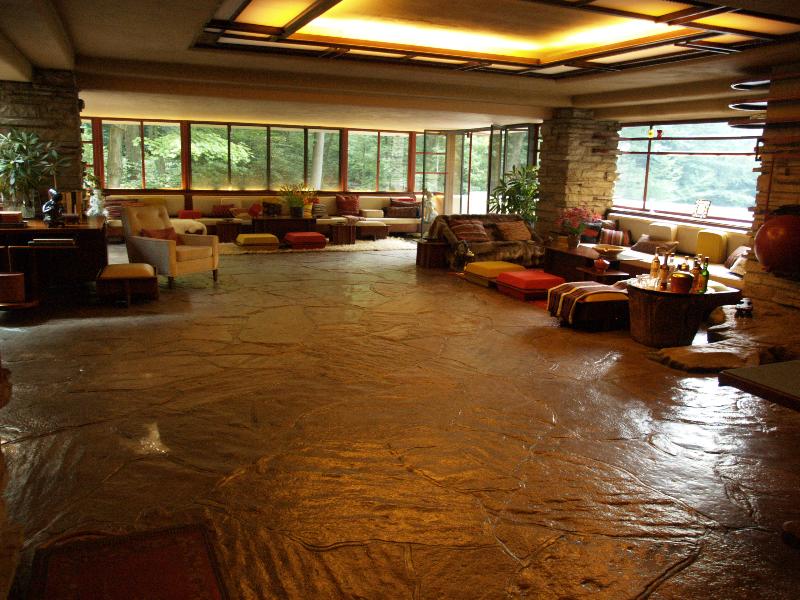
As you can see from the picture above, Wright loved big spaces. He used different techniques to make a room appear bigger than it actually is. This is an art form in itself. He intrigued the human eye by having all the exterior walls fitted with windows. This gives the feeling that the room extends beyond the wall to the outside. He also raised the lights in the ceiling to give the feeling of the room being taller than it actually is. This is also an example of a Great room because there is another room to the left that is open up by taking away a wall.
Wright loved nature. He didn’t like the look of a stick building thrown into the wilderness. He said that it didn’t look natural. Wright wanted his buildings to tie into the surroundings. He didn’t want the natural habitat to be destroyed. He also used materials that blended win the surroundings and even some materials from the surroundings. The picture below is from a house in New York that Wright designed more than 50 years ago that has been built.


As you can see the house blends with the rocks, and it even uses the rock as a piece in the house. Wright didn’t want to knock off any of the rock. He just wanted to build around the rock and use it as a piece in the house. The amount of time he put into this building was incredible. He believed that this was his greatest house he ever designed. But unfortunately he never had the chance to see that it was built. This is another reason why architecture is an art from that anyone can appreciate. The engineering that made this house possible is evidence enough.
Another building that exemplifies art is the Edgar Kaufmann House also known as Fallingwater located in Mill Run, Pennsylvania as seen in the picture below.

Edgar Kaufmann and his family would vacation at this spot and loved it so much that they wanted to build a house by it. Well Frank Lloyd Wright went one step better; he built a house over the stream that feeds the waterfall. The stream flows around, under and at one point through the house. Wright loved to use nature as a focal point. He used the decks and terraces to mimic the rock’s shape to help make the house look like it grew up from the ground. This is how Wright wanted his works to be appreciated by all those who see it. He wanted to the house to look like it belonged there.
Wright didn’t only think about just houses as a whole or mixing room together, he also thought about individual rooms. I saw this five years ago when I had the opportunity to visit Taliesin West. Walking through the house I noticed something strange about the dining room. The ceiling was significantly lower than the rest of the house. I was 6’6” at the time and if I walked straight into the dining room without slouching, the ceiling would have hit me in the chest right below the neck. It was about 6 feet in height. I asked why that was and the tour guide said that Wright liked to play with size. Wright also believed that the dining room was for eating and not standing and socializing. So by lowering the ceiling it forced people to sit down. Now that is a piece of art. He manipulates all those who look at it to sit down just like he wants to. Isn’t that what all artists are trying to do? Make people see what they want them to see?
Wright wasn’t trying to be an artist, he was trying to make houses more appealing to the eye and comforting to the people in them. However, after seeing his houses no one can deny that he was an artist. He changed the idea of living in “box” rooms to big open spaces that encouraged families to be with each other. Wright didn’t like eye soars of houses that looked like they were dropped out of the sky. Instead he designed and built houses that blended with the nature that surrounds them. He even used nature inside the house. Wright manipulated dimensions of rooms to fit their needs. Like the dining room at Taliesin West forcing people to sit down. Frank Lloyd Wright built and made things to catch people’s attention and appreciate what he was doing to houses. All of these things show how Frank Lloyd Wright is an artist.
Sources:

