Showing posts with label Abstract Expressionism. Show all posts

Friday, July 17, 2009

Sources of Modern Masters: Willem de Kooning's Women

Dutch-born Willem de Kooning (1904-1997) came to the United States at the age of 26 as an illegal immigrant. In the thirties, he, along with many other artists, worked for the Works Progress Administration (WPA). The WPA was a boon to artists, giving them living wages in exchange for painting murals. Through the thirties and forties, de Kooning's style changed from Le Nain-esque genre paintings to his now-signature action painting:

Willem de Kooning, Two Standing Men (1938), oil and charcoal on canvas, 61 x 45 inches.
Formerly collection of Thomas Hess.


Willem de Kooning, Asheville (1948), oil and enamel on cardboard, approx. 26 x 32 inches.
The Phillips Collection, Washington D.C.


Painting his entire life, de Kooning was in his forties when he had his first one-man show. His abstract style received excellent reviews from critics, and in 1948, influential critic Clement Greenberg called him "one of the four or five most important painters in the country."

In 1953, de Kooning exhibited this painting:

Willem de Kooning, Woman I (1950-52), oil on canvas, approx. 6'4" x 58"

The female form, one of the most cherished forms and subjects of Western art, has been outlined with thick blue, green, black, yellow and orange slashes. She is seated, baring her breasts and teeth. de Kooning's brushstrokes blur the figure into the background but the intensity of her gaze keeps our eyes transfixed to her form. Look at the foot at the bottom edge of the canvas. The pink paint for the ankle and foot pushes out of the blue strap of her shoe, towards the viewer. Her hands, crossed in her lap, are long and claw-like. The physicality in de Kooning's paint application is evident on every inch of the canvas - vertical, horizontal, thick, thin, fast lines. His Woman is mesmerizing, and also a bit terrifying.

The subject of his painting is clear: the human form, and it was a subject he'd painted before and would continue to paint for the rest of his life. However, there was (and remains) much speculation into de Kooning's specific inspiration. At the time of its debut, critics surmised that the menancing appearance of Woman was inspired by a deep-seated fear and/or hatred of women.

The subjects of the Woman series bare their teeth and confront the viewer with enormous eyes, and the speed of de Kooning's brushstrokes suggested knife wounds. Compared to this, even Manet's Olympia looks downright cuddly. Speculators looked to his mother, a Dutch barmaid, and his wife, Elaine, an artist and critic, as sources for any indications of these feelings. Elaine eventually forced Hans Namuth to take a picture of her next to the woman "to establish once and for all that I did not pose for these ferocious women":

Photo taken by Hans Namuth (1953).

But even Elaine was surprised that "I and the painted lady seemed [like] mother and daughter. We're even smiling the same way."

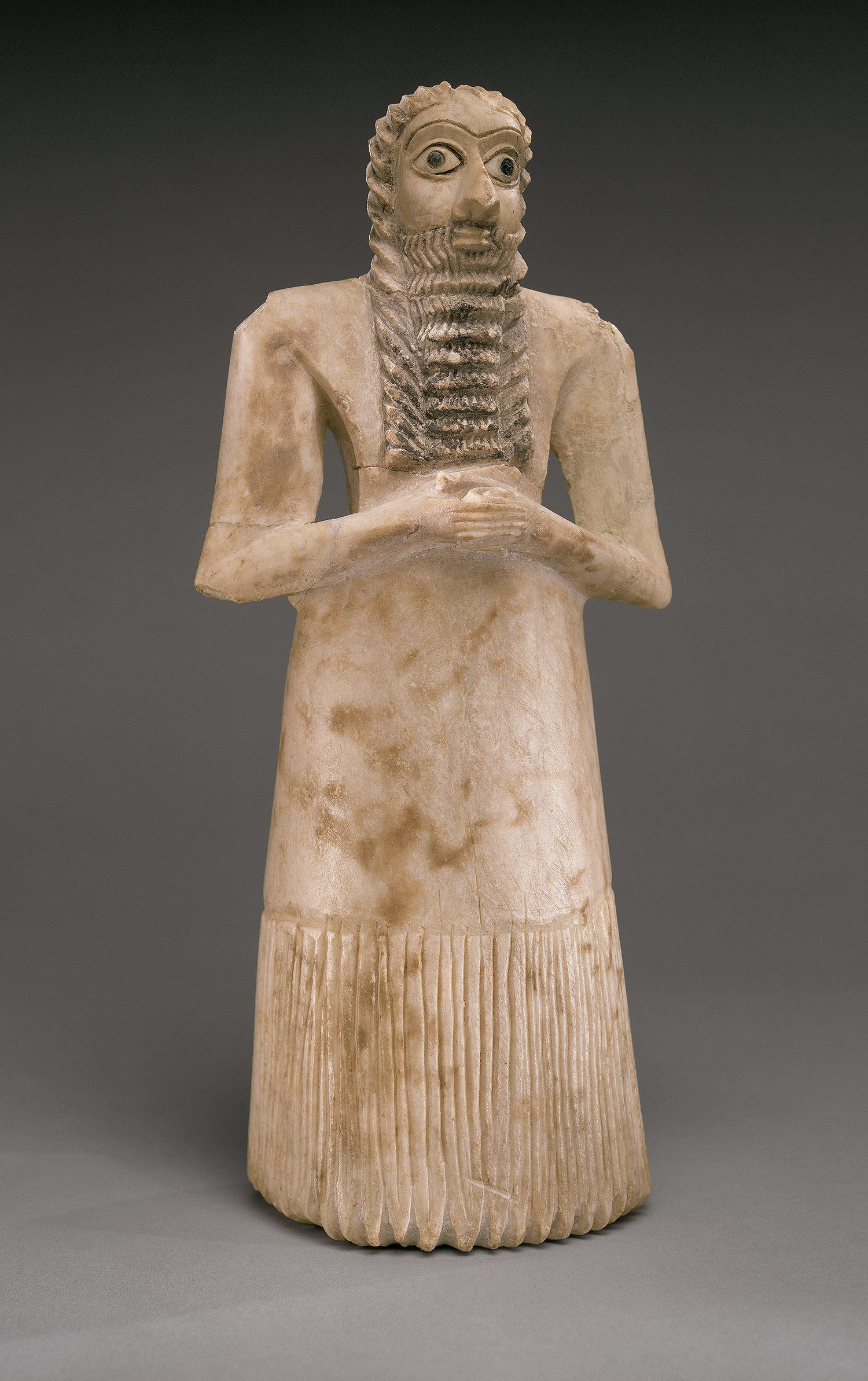
Yet de Kooning never publicly admitted that his art was about anything but relating the eternal form, the human figure, to his everyday experiences: "The Women had to do with the female painted through all the ages ... I look at them now [in 1960] and they seem vociferous and ferocious. I think it had to do with the idea of the idol, the oracle, and above all, the hilariousness of it." His Women were based on de Kooning's personal experiences with, yes - the ones he knew and the ones he observed: pin-up models, the women shopping on 14th street, and perhaps yes, even his wife and mother. And beyond the immediate experiences, de Kooning also looked to the past:

Standing Sumerian male worshipper, c. 2750-2600 BCE, alabaster and black limestone,
11 5/8", from Mesopotamia.
Acquired by the Metropolitan Museum of Art in 1940, New York City.


Venus of Willendorf, c. 20,000 BCE, limestone, height 4 3/8" .
Discovered in Austria in 1908.
Naturhistorisches Museum, Vienna.


Though de Kooning did mention that his paintings also reminded him of water: his childhood home in the Netherlands, or a friend's home in East Hampton. He said that he would "get a feeling" of the ocean when painting a Woman picture in the city.

Monday, May 4, 2009

New Art City by Jed Perl

Contemporary American art critic Jed Perl’s book, New Art City (2005) presents mid-century New York City as participant, catalyst, and grand stage of Abstract Expressionism. Using quotes, memories, photographs, literature, and critical writings of the period, Perl invokes the cultural and intellectual milieu that fermented throughout downtown New York City. The result is a narrative of cultural and historical conditions that, according to Perl, inevitably lead to America’s greatest contribution to modern art. It is a story of heroes, antiheroes, big ideas and villains, all contributing to the artistic landscape spanning from its foundations in the 1930s through the repercussions in the late 1960s and 70s. In addition, Perl acts as cultural and urban geographer through his exploration of the now-legendary places of Abstract Expressionism, such as artists’ studios, the Cedar Tavern, the Museum of Modern Art, the Solomon R. Guggenheim Museum, and the City itself.

Perl’s 557-page book, not including notes and endnotes, is organized into five sections with each section consisting of 2-4 chapters. The book proceeds chronologically, beginning with painter Hans Hofmann, a German émigré who ran a legendary studio school beginning in 1933, and ending in the mid-1970s with Minimalist sculptor Donald Judd and painter Fairfield Porter. Using these artists as bookends, Perl's narrative begins with the introduction of the European avant-garde to American artists, the ascent of the American art scene alongside the promotion of American-style modernism, and a "descent" into ironic conceptualism. Perl loves that the United States took center stage after WWII: "What was clear to just about all the artists was that the ball was in New York's court. The grand old themes now belonged to Manhattan. These themes included the artist's relationship with society; the struggle to define and redefine quality; and the place of meaning in art, and especially, now, in abstract art." Art historians will recognize the validity of this statement and also appreciate the romanticism it implies.

Perl asks, “If the New York artists were dialecticians first and last- instinctive students of the histories of style, which they spliced and diced, accepted and rejected- who can wonder that collage itself and the image of New York as a grand collage were so dear to their hearts?” The introduction of a facet of the city's geography or personality then connecting it to the artists and art of the time is an effective technique. In a very accessible (and still high-brow) manner, New Art City is a study of the metaphorical spaces and communities within an urban context.

This structure allows Perl to support his thesis that the relationship between the city and artist results in extraordinary American art, as well as an effective way to capture the zeitgeist. New Art City overlaps people, places, ideas, quotes and memories trying to recreate this heady cultural milieu, the diverse ideas and people and reactions and relationships, in order to give context to the revolutionary ideas and art that from it. About the legendary Cedar Bar where the Abstract Expressionists would meet/drink/argue/laugh, he quotes the diary of actress and director Judith Malina:
"[The opening of the Ninth Street show] was a great splash. Some wonderful painters have rented a large loft, painted it white, and hung hundreds of canvases in the bare rooms. We seek relief from the intense night heat outside, under the sign painted by Franz Kline, lit from the window of a studio across the street. I talk for a long time with John Cage about painting and music ... After the exhibit there's a party at the Three Arts Club ... Clement Greenberg jitterbugs violently to Louis Armstrong's 'I Ain't Rough.' Sidney Janis jitterbugs conservatively and does a very suave tango."
This is a recollection of America's foremost modernist art critic (Greenberg), one of the most influential art dealers in the 20th century (Janis), a ground-breaking composer (Cage), and an Abstract Expressionist painter (Kline), all in the same place at the same time. The city is the grand stage and catalyst for the art, and New Art City is clearly a love letter to Manhattan and what Perl calls "the Silver Age."

Perl's prose uses winding sentences to impress upon the reader the force of the heady, "anything is possible" moment of 1950s and 1960s NYC. His words become long sentences, turning into incredibly rich descriptions of not only the artist and art, but the city as well. This writing style (re)creates a once-in-lifetime cultural zeitgeist. For example, he writes about assemblage artist Joseph Cornell and sculptor David Smith,
"David Smith is an alchemist. Whether he works with brand-new sheets of stainless steel or with the exquisitely forged iron tools abandoned in an Italian factory, he is a master of poetic possibility, removing materials from their ordinary contexts and giving them a metaphoric sizzle. Both Smith and Joseph Cornell, in their very different ways, offer lyric variations on life's hurly-burly. Their relationship with the city is so intuitive as to sometimes feel uncanny, and that feeling is only underscored when we consider that the very locations where they worked in New York had been given, well before they arrived, names that suggest the stamp of their personalities. Everybody who has ever thought about Cornell has noted the serendipity of his having lived on Utopia Parkway. As for David Smith, born three years after Cornell, in 1906, he had a similarly propitious encounter with a certain name in the borroughs of New York, this one on the Brookly waterfront, where the artist and his wife, the sculptor Dorothy Dehner, one day in the fall of 1933 came upon what Smith described as 'a long rambling junky looking shack called Terminal Iron Works.'"
In this excerpt, we see how Perl merges artistic sensibility with the personality of the city. For Perl, Joseph Cornell's meticulously created boxes are a way of heroizing minutiae - the discarded and overlooked that can be found in the streets (literally, gutters) and the hole-in-the-wall stores where one can find personal gems. Cornell's boxes are personal artistic expressions and also metaphors for someone trying to make sense of the endless visual sensations a person encounters in a lifetime. Smith's metal sculptures parallel NYC's skyscrapers used as proof of modernity, democracy, daring creativity, heroism and capitalism: the steel aesthetic. Smith's sculptures can be metal drawings or solidly-balanced geometrics. Collectively, Smith's pieces are now collectively known as Terminal Iron Works due to their durability (in this case, the permanence of the medium and also their visual appeal).

Perl's strength is his very clear prose: he has a beautiful way of describing the art and also describing the milieu. His descriptions, in my opinion, are dead-on and he has a lovely way of evoking not just what the art looks like but how someone looks at it. Of one of my favorite artists, Ellsworth Kelly, he writes of Kelly's "hyperbolic simplicity." Look at this or this or this or these panels at the Art Institute of Chicago:


Author photos of Ellsworth Kelly's Chicago panels, taken in April 2009.

Now, tell me that "hyperbolic simplicity" isn't a wonderful way to describe the individual works as well as Kelly's aesthetic.

New Art City is a modernist narrative because there are clearly heroes and villains. There is no postmodern ambiguity - only the sincere, modernist belief that individuals can achieve great things. Perl's heroes are the great American modernists but he clearly has his preferences: Willem De Kooning, Cornell, Kelly, Clement Greenberg. Marcel Duchamp is posited as the villain of Perl's story because of his Dada art and spurious, needling ideas about low art. At times, Perl's story lags when it seems like an endless amount of anecdotes and name-dropping, but if you're an art history junkie like me then the stories may also enthrall you.

If you are interested in reading more of Perl's work, then check out his his art criticism at The New Republic.

(Post adapted from my GoodReads.com review.)